7 April 2016

Establishment of First Horticulture University in Haryana at Karnal

Establishment of First Horticulture University in Haryana at Karnal will fulfill the long pending need of the people of the State- Shri Radha Mohan Singh
University is expected to help in improving productivity levels and to adopt appropriate crop diversification to suit the agro climatic conditions of the region- Shri Singh
Foundation Stone laying Ceremony of Haryana State University of Horticultural Sciences, Karnal

            Union Agriculture and farmers Welfare Minister, Shri Radha Mohan Singh today laid the Foundation stone of Haryana State University of Horticultural Sciences  at Karnal, Haryana. On the occasion Shri Singh said that the establishment of first Horticulture University in Haryana will fulfill the long pending need of the people of the State. A full fledged horticultural university will cater the needs to support the gap between teaching, research and extension activities in the state and will establish the convergence and synergy todisseminate latest technology and horticulture education to our young generation, besides identifying strategies for further development.
Shri Singh said that on the Horticulture development, Haryana holds tremendous potential on account of its fertile lands, favorable climate and water resources. Farmers in Haryana have also started taking up horticulture crops as a separate viable economic activity.  Haryana has made vision to make Modern Fruit and Vegetable Cultivation State and to give a boost to the growth of horticulture and also creation of market and post harvest infrastructure. Agriculture Minister expect that this shall also demonstrate significant improvement in production and productivity of horticultural crops to double the income of the farmers, and help in achieving self-sufficiency. This university is expected to help in improving productivity levels and to adopt appropriate crop diversification to suit the agro climatic conditions of the region.
Agriculture and Farmers Welfare Minister said that Haryana is leader in adopting Mission for Integrated Development of Horticulture programme and giving priority for protected cultivation and post Harvest management. The State leap forwarded to increase area under horticultural crops from 2.0 lakh hectare in the year 2002-03 to 4.5 lakh hectare during 2013-14 and production increases from 2.51 million tonnes to 6.30 millin tonnes during same period. State has planned to increase the area to 9.0 lakh hectare with production to 27 million tonnes in next decade.
Shri Singh said that this University will also act as a skill development centre to cater the larger demand for trained manpower in the production, post harvest and processing industries. There is a huge scope for agro-processing industries like mango, citrus, aonla, strawberry in fruits and pea, tomato, potato, carrots, garlic, onion in vegetables and mushroom. Shri Singh further said that due to its proximity to major markets like Delhi and tri-city of Chandigarh it offers an excellent marketing and export channels.

National Hydrology Project

National Hydrology Project
The Union Cabinet chaired by the Prime Minister Shri Narendra Modi has given its approval toImplementation of the National Hydrology Project.  It will be a central sector scheme with a total outlay of Rs. 3679.7674 crore.  This includes Rs.3,640 crore for National Hydrology Project (NHP) and Rs. 39.7674 crore for National Water Informatics Centre (NWIC) to be taken up in two stages.  It also provides for establishment of NWIC as an independent organization under the control of Ministry of Water Resources, River Development and Ganga Rejuvenation (MoWR, RD&GR).

The NHP will help in gathering Hydro-meteorological data which will be stored and analysed on a real time basis and can be seamlessly accessed by any user at the State/District/village level.  The project envisages to cover the entire country as the earlier hydrology projects covered only 13 States.

The components of the proposal are:
a)             In Situ Hydromet Monitoring System and Hydromet Data Acquisition System.
b)             Setting up of National Water Informatics Centre (NWIC).
c)             Water Resources Operation and Management System
d)            Water Resources Institutions and Capacity Building

The NHP will result in the improvement of:

1.      Data storage, exchange, analysis and dissemination through National Water Informatics Centre.
2.      Lead time in flood forecast from 1 day to at least 3 days
3.      Mapping of flood inundation areas for use by the disaster management authorities
4.      Assessment of surface and ground water resources in a river basin for better planning & allocation for PMKSY and other schemes of Govt. of India
5.      Reservoir  operations  through   seasonal  yield   forecast,   drought  management, SCADA systems, etc.
6.      Design of SW & GW structures, hydropower units, interlinking of rivers, Smart Cities.
7.      Fulfilling the objectives of Digital India.
8.      People Centric approach:  The programme envisages ultimate aim for water management through scientific data collection, dissemination of information on water availability in all blocks of the country and establishing of National Water Information Centre.  The automated systems for Flood Forecasting is aimed to reduce water disaster ultimately helping vulnerable population.  It is people and farmer centric programme as information on water can help in predicting water availability and help farmers to plan their crops and other farm related activities.  Through this programme India would make a place among nations known for scientific endeavours.

Out of the total outlay of Rs. 3679.7674 crore, Rs.3,640 crore has been earmarked for National Hydrology Project  while Rs. 39.7674 crore has been kept aside for NWIC.   Out of the total outlay, fifty per cent of the amount that is Rs.1839.8837 crore, would be World Bank loan which would be repaid by Central Government. The remaining 50% that is Rs. 1839.8837 crore would be Central Assistance from the budgetary support. The entire World Bank's Loan component and Central assistance to the States and Central Organisations shall be passed on to them as Grants.

Elucidation on the impact of the Project:

a)      Development of real time flood forecasting and reservoir operations in a manner that does not result in sudden opening of gates which inundates the area down below;
b)      It will facilitate integrated water resource management by adopting river basin approach through collation and management of hydro-meteorological data.  This will also help in water resource assessment – as surface as well as ground water, for water resource planning, prioritize its allocations and its consumptive use for irrigation;
c)       It will help in providing real time information on a dynamic basis to the farmers about the ground water position for them to accordingly plan their cropping pattern;
d)     This will also help in promoting efficient and equitable use of water particularly of ground water at the village level;
e)      This will also provide information on quality of water
Background

The National Hydrology Project (NHP) is intended for setting up of a system for timely and reliable water resources data acquisition, storage, collation and management. It will also provide tools/systems for informed decision making through Decision Support Systems (DSS) for water resources assessment, flood management, reservoir operations, drought management, etc. NHP also seeks to build capacity of the State and Central sector organisations in water resources management through the use of Information Systems and adoption of State-of-the-art technologies like Remote Sensing.

The MoWR, RD&GR has adopted a paradigm shift in the management of water resources of the country by adopting a river basin approach, In order to efficiently use and manage water resources of the country; adequacy of data, resource assessment, decision support systems, etc. are a prerequisite for allocation and prioritization of this fast depleting resource.

5 April 2016

UKPSC Notifies advertisement for RO / ARO.SAMVEG IAS DEHRADUN

UKPSC Notifies advertisement for RO / ARO

Batch start :16th April 2016 (counselling time : 5.30pm onwards)

#UKPSC #UKPCS #RO #SAMIKSHAADHIKARI #PCS

http://ukpsc.gov.in/files/ROA_advt.pdf

http://ukpscappl.gov.in/soaproaro/


Pearly nautilus may get extra protection

Pearly nautilus may get extra protection


The CITES authorities have sought the views of their Indian counterparts for determining the qualification of the species.

Nautilus pompilinus, the pelagic marine mollusc with one of the oldest animal lineages on the planet, may get an extra global legal protection soon.
The palm-sized adult animal, which could live up to 20 years in ocean depths, may soon be included in the Appendix 2 of the Convention on International Trade in Endangered Species of wild flora and fauna (CITES). The CITES authorities have sought the views of their Indian counterparts for determining the qualification of the species.
Marine fisheries experts have recommended that the species shall be listed considering the rarity of the animal and its poor regeneration capacity. The species is commonly known as pearly nautilus considering the pearly nacre on its external shell. The animal has a chambered shell with limited mobility. It’s commonly found in ocean depths of 700 metres, explained a scientific evaluation paper.
Earlier researches have pointed out that the “low egg number, late maturity, long gestation and long life span of the Nautilus make the species vulnerable.” The shell of the animal is traded widely across the world though there is no targeted fishery in India. However, there are reports of some targeted catch from Indonesia and Philippines. At times, marine researchers have reported the accidental catch of the bright orange banded species during mid-water trawling, pointed out a researcher.
The species has been accorded legal protection by including it in the Schedule 1 of the Wildlife Protection Act, 1972. The hunting or possession of the animals included in the Schedule is a punishable offence in the country. Some animals, which die a natural death may float in water and land in shores, which are picked up by collectors. The fancy look and the shiny lustre make it a collector’s item. The shells are believed to be fetch high price in trade. There are reports of the shells, which are washed ashore, collected and clandestinely traded.
The species has relatively small population and are vulnerable to fisheries and also anthropogenic activities. Yet, no scientific data is available on its population in India. The species has not been currently assessed by the International Union for Conservation of Nature, says a scientific report.
The inclusion of the animal in the CITES list would ensure a global regulation in its trade. It would also extend the legal cover globally for the species, which is considered as rare link to the evolutionary history of animals, he said.

How MCLR will affect your home loan

How MCLR will affect your home loan

For new borrowers, home loan rates will be automatically reset either yearly or every six months

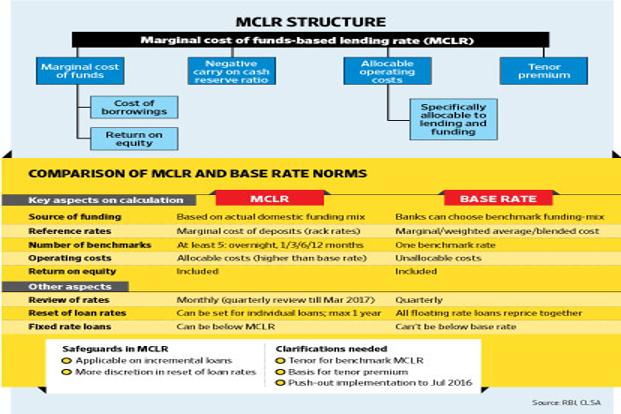
State Bank of India (SBI), India’s largest lender, was the first to announce the new marginal cost-based lending rate (MCLR), on 1 April 2016. This is the new benchmark lending rate and it replaces the base rate for new borrowers. SBI has introduced seven MCLRs for periods ranging between overnight and three years. While MCLR will be the benchmark rate for new borrowers, for existing borrowers, the base rate regime will continue.
Here’s what the new rate means, and how it affects you.
What is MCLR?
MCLR is the new benchmark lending rate at which banks will now lend to new borrowers. Till 31 March 2016, banks used the base rate as the benchmark rate to lend.
MCLR is built on four components—marginal cost of funds, negative carry on account of cash reserve ratio (CRR), operating costs and tenor premium.
Marginal cost of funds is the marginal cost of borrowing and return on net worth for banks. The operating cost includes cost of providing the loan product including cost of raising funds. Tenor premium arises from loan commitments with longer tenors. According to brokerage and investment group CLSA, the source of funding for a bank is based on actual domestic funding mix. MCLR is closely linked to the actual deposit rates.
“If one-year term deposit is at 7.50%. Then one-year MCLR will be 7.50% plus CRR, operation cost and tenor premium,” said Ashutosh Khajuria, executive director, Federal Bank Ltd.
The Reserve Bank of India (RBI) has asked banks to set at least five MCLR rates—overnight, one month, three month, six month and one year. Besides these, banks are free to set rates for longer durations as well. The rates have to be reviewed on a monthly basis, but banks that don’t have the capacity to do monthly reviews on can do so quarterly till March 2017.
MCLR-linked loans will be reset for a maximum of one year. So, you will have a new interest rate on your home loan at a pre-decided time and for a maximum period of one year.
Banks are also allowed to determine a spread that is higher than MCLR. Depending on your credit profile, banks will decide this. “The spread will be decided based on credit risk and tenor. For credit risk, in case of an individual borrower, we will look at Cibil rating. Depending on the credit worthiness of the customer, we will set the spread above MCLR. Currently, the spread is in the range of 25-60 basis points (bps) for home loans,” K.V.S. Manian, president-corporate, institutional and investment banking, Kotak Mahindra Bank Ltd. One basis point is one-hundredth of a percentage point.
Not all loans will come under this rate. For instance, loans covered by government schemes where banks have to charge interest rates as per the scheme are exempted from being linked to MCLR as the benchmark for determining interest rate.
How does it work?
If you plan to take a floating rate home loan, your loan will now be linked to MCLR. Most banks have announced five to seven rates. For home loans, banks will either use the six-month MCLR or the one-year MCLR as the benchmark rate. Therefore, from now, all floating rate loan agreements will have a reset clause at a pre-specified interval. “Banks can decide on the tenor that they want to use to reset for longer-term loans such as home loans. We have decided to reset home loan interest rates at a six-month frequency. Hence, the six-month MCLR will be applicable for home loans,” said Manian. Kotak Mahindra Bank has announced 9.40% as its six-month MCLR and the home loan will be reset every six months in case of any changes in MCLR. If you have a home loan, the bank will reset the rate automatically at a pre-specified date.
However, banks such as SBI and ICICI Bank Ltd have set one-year MCLR as the benchmark for home loans. For instance, for salaried individuals, ICICI Bank has set a floating rate home loan at one-year MCLR of 9.20% with a spread of 25 bps for loans of up to Rs.5 crore. So, the interest rate will be 9.45%. The bank’s website stated that this will be valid till 30 April 2016. Though the MCLR is reviewed monthly, your home loan will be reset every year automatically, depending on the agreement with the bank. For instance, if you take a Rs.30-lakh loan on 1 April this year, one-year MCLR is at 9.20% and spread on it is 25 bps, your home loan will be 9.45%. You will pay instalments at this rate for the next one year. If on 1 April 2017, one-year MCLR gets revised to 9.15%, your home loan interest rate will get reset at 9.40% (MCLR of 9.15% plus spread of 25 bps). Accordingly, your instalment or loan tenor may change.
According to a report by Ambit Capital Pvt. Ltd, RBI gave banks the provision of a reset period to partly smoothen the impact of changing rates on banks’ margins (as deposits re-price with a lag, reset periods allow bank to adjust the timing of loan pricing). As the concept of reset period contravenes with the RBI’s objective of quick transmission of monetary policy, the RBI has capped reset period at one year.
Though retail loans are likely to be set at six months to one-year MCLR tenors, corporate loans may be set at shorter tenors. “Due to complexity in the retail product, a pre-specified reset has been decided. When it comes to corporate loans, there is a possibility to negotiate across the multiple sets of rates that are available,” said Manian.
Can an existing borrower who is on a base rate regime move to MCLR? According to RBI, existing loans and credit limits linked to base rate will continue till repayment or renewal, and banks will have to continue publishing base rates as well. Existing borrowers can move to MCLR-linked loans at mutually acceptable terms and these loans will not be treated as foreclosure of existing facility.
What you should know
The MCLR-linked home loan rate is currently marginally lower than a base rate-linked loan. For instance, SBI was offering home loans between 9.50% and 9.55% till 31 March. From 1 April, the rate is lower by 10 bps and ranges between 9.40% and 9.45%.
According to the Ambit report, new MCLRs are not so different from base rates: “...even if benchmark rates would have fallen, the effective loan pricing for borrowers might not have changed much. This is because banks could change spreads over benchmark rates,” the report noted.
Home loan rates will now depend on the bank’s choice of reset period—six-month or one-year MCLR rate and spread rather than one common base rate and spread. According to a Centrum Broking Ltd report, while MCLR is intended to ensure effective policy transmission, past studies, including references to global banks, suggest limited rate transmission to end-user. Hence, its effectiveness in the longer run will need to be assessed, the report noted.
Existing borrowers should wait for the new system of calculation to settle before deciding to switch loans

The changing pattern of healthcare in India

The changing pattern of healthcare in India

The government’s allocation to healthcare as a percentage of GDP has fallen to 1.05% in 2015-16 from 1.47% in 1986-87
The evolution of healthcare in India over the past 25 years has been a mixed bag. While key health metrics such as the infant mortality rate (IMR) and maternal mortality ratio (MMR) have come down substantially, healthcare expenses have shot up—a direct fallout of lower public health spending. The government’s allocation to healthcare as a percentage of the country’s gross domestic product (GDP) has fallen to 1.05% in 2015-16 from 1.47% in 1986-87.
IMR has fallen to 41 per 1,000 live births in 2013 from 88 in 1990, according to a United Nations report ‘Levels and Trends in Child Mortality’ released in 2015. Similarly, according to a World Health Organization (WHO) report released in 2014, MMR in India has declined from 560 deaths per 100,000 live births in 1990 to 190 in 2013.
“Evidence from the ground supports this. We have made gains in maternal and child health by establishing public health systems in rural areas. The investments made through National Rural Health Mission (now under National Health Mission) have paid dividends in this area,” said Vandana Prasad, national convener, Public Health Resource Network and formerly with the National Commission for Protection of Child Rights.
But India has failed its citizenry when it comes to expenses on healthcare. Health surveys by the National Sample Survey Organisation (NSSO) show that since the 1990s, the dependence of Indians on private healthcare has risen sharply. In 1986-87, 60% of people availed of public health services and the rest private healthcare, according to the 42nd NSSO report. But by 2014, this trend was reversed, with only 41% availing of public healthcare, according to the 71st NSSO report released last year. The decline in dependence on public healthcare is sharper in urban areas—from 60% in 1986-87 to almost 32% in 2014.
The NSSO rounds also show a corresponding three-fold increase in out-of-pocket expenditure or private health expenses of households. People spent Rs.3,561 per hospitalization in 1995-96, according to the 52nd NSSO report. It increased toRs.18,268 in 2014.
“Out-of-pocket expenditure is the main cause of worry for the patients. A number of people fall from above poverty line (APL) category to below poverty line (BPL) category because of this. Nearly 70% of out-of-pocket expenditure is due to medicines. That has to be addressed,” said Rajesh Kumar, head of the department of community medicine and school of public health, Post Graduate Institute of Medical Education and Research (PGIMER), Chandigarh.
The rise in out-of-pocket expenditure is a direct outcome of the fall in the government’s budgetary support to healthcare.
“By the end of 1980s, public health spending had increased to 1.5% of India’s GDP. Since then, there was declining trend in public spending on health, which reached to only 0.6% of GDP in the 1990s. Since then, it has improved a little up to 1.2%, but nowhere close to the 12th five-year plan (2012-17) target of 2.5% of GDP,” said Ravi Duggal, health economist and country coordinator of non-profit International Budget Partnership. “What this under-financing did was to reduce the credibility of public health institutions among general people. And doctors and nurses left the public health system, creating huge vacancies in primary health centres and public hospitals,” he added.
The increasing burden of both communicable and non-communicable diseases, too, is a challenge. While diarrhoea, respiratory infections and pre-term birth complications continue to affect India, lifestyle diseases such as heart diseases, stroke, pulmonary diseases and diabetes are now leading causes of premature death. Non-communicable diseases such as cardiovascular diseases, cancer, chronic respiratory diseases and diabetes account for nearly 60% of all deaths in India, according to the WHO.
The economic burden of these lifestyle diseases accounts for about 40% of all hospital stays and roughly 35% of all recorded outpatient visits, according to a 2014 report by the World Economic Forum and Harvard School of Public Health. The report further added that the probability of dying during the most productive years—between 30 and 70—from one of the four main non-communicable diseases is a staggering 26%.

Tracking the Panama Papers

Tracking the Panama Papers

The list of Indians include Amitabh Bachchan, Aishwarya Rai Bachchan, K.P. Singh and Gautam Adani’s elder brother Vinod Adani, among others

Over 500 Indians figure among a list of individuals who have paid Mossack Fonseca, a law firm headquartered in tax haven Panama known for its factory-like production of offshore companies for its worldwide clientele of the well-heeled, to set up offshore entities in tax havens around the world, according an Indian Express report.
Mossack Fonseca won’t discuss specific cases of alleged wrongdoing, citing client confidentiality, reports the Guardian.
They find mention in more than 11 million documents from the secret files of Mossack Fonseca, in an unprecedented leak that is being called the Panama Papers by the media the world over.
From film actors Amitabh Bachchan and Aishwarya Rai Bachchan to businessmen including DLF owner K.P. Singh and nine members of his family, and the promoters of Apollo Tyres and Indiabulls to Gautam Adani’s elder brother Vinod Adani, to politicians Shishir Bajoria from West Bengal and Anurag Kejriwal, the former chief of the Delhi unit of Loksatta Party, the Indian Express has verified 300 addresses. The list includes scores of businessmen with addresses in nondescript neighbourhoods in Panchkula, Dehradun, Vadodara and Mandsaur.
A close scrutiny of The Panama Papers by The Indian Express also reveals details of hitherto unknown deals, in some cases involving the Indian government, too.Read more
The leak shows how the rich and famous can exploit offshore tax shelters and reveals an unprecedented pattern of corruption worldwide for 40 years, including maneuvers by major banks who created the hard-to-trace companies. World leaders or associates who have embraced anti-corruption platforms are featured throughout.
The massive leak of documents exposes the offshore holdings of 12 current and former world leaders and reveals how associates of Russian President Vladimir Putin secretly shuffled as much as $2 billion through banks and shadow companies, according to ICIJ or the International Consortium of Investigative Journalists’ report on Panama Papers .
The leak also provides details of the hidden financial dealings of 128 more politicians and public officials around the world. The cache of 11.5 million records shows how a global industry of law firms and big banks sells financial secrecy to politicians, fraudsters and drug traffickers as well as billionaires, celebrities and sports stars. These are among the findings of a yearlong investigation by the International Consortium of Investigative Journalists, German newspaperSüddeutsche Zeitung and more than 100 other news organizations.
The files expose offshore companies controlled by the prime ministers of Iceland and Pakistan, the king of Saudi Arabia and the children of the president of Azerbaijan.
The network of secret offshore deals and vast loans worth $2billion has laid a trail to Putin, reports the Guardian.
Though the Russian president’s name does not appear in any of the records, the data reveals a pattern—his friends have earned millions from deals that seemingly could not have been secured without his patronage. The documents suggest Putin’s family has benefited from this money—his friends’ fortunes appear his to spend, added the Guardian.
The leak of secret documents reveals another side to Putin and classical cellist and conductor Sergey Roldugin’s friendship. The records show Roldugin is a behind-the-scenes player in a clandestine network operated by Putin associates.
The BBC reported that the leak reveals information about 72 current or former heads of state, including Syria’s president Bashar al-Assad, Egypt’s former president Hosni Mubarak, and Libya’s former leader Muammar Gaddafi. It reported Icelandic Prime Minister Sigmundur Gunnlaugsson stored millions of dollars of investments in Iceland’s major banks in an offshore company.
Sueddeutsche Zeitung reported Juan Pedro Damiani, the Uruguayan lawyer who is president of the country’s most popular soccer team and a FIFA ethics expert, managed companies through which FIFA members may have received bribes.
The ICIJ also state that the documents contain “the names of nearly 20 high-profile soccer players, past and present, representing some of the globe’s best-known professional football clubs, including Barcelona, Manchester United and Real Madrid”, as well as “current or former owners of at least 20 major soccer clubs, including Internazionale Milano and Boca Juniors”.
Outside of football, the ICIJ states that the names of at least five golfers, as well as a number of NHL players, appear in the documents.
The ripple effects of the leak have already started to show, at least in Iceland.
Iceland’s prime minister Sigmundur Davíð Gunnlaugsson is this week expected to face calls in parliament for a snap election after the Panama Papers revealed he and his wife is among several leading politicians around the world with links to secretive companies in offshore tax havens, reported the Guardian.
An anonymous source apparently tipped off Suddeutsche Zeitung, an investigative newspaper in Germany, which then shared the information with ICIJ.
The ICIJ report states that it includes information on “29 billionaires from Forbes list of top 500 Richest” as well as movie star Jackie Chan, and soccer star Lionel Messi, who ranked fourth on Forbes’ 2015 list of highest paid athletes.
The Forbes report lists the billionaires and former billionaires who are mentioned in stories reporting on The Panama Project or have ties to entities mentioned. The list is incomplete.
So, how did the Panama agent offer secrecy? The offshore entity need not appoint natural persons as directors or have individuals as shareholders. The Registered Agent, Mossack Fonseca in this case, offers its own executives to serve as shareholders or directors. Sometimes, an intermediary law firm or a bank acts as a director or a nominee shareholder. So the real beneficiary remains hidden,reported the Indian Express .
Criminal investigations are sure to follow in dozens of countries, and more revelations are sure to emerge as the documents are pored over more thoroughly.
Though the details are shocking, the leaks also offer the most granular look ever at a banal reality that’s long been hiding in plain sight. Even as the world’s wealthiest and most powerful nations have engaged in increasingly complex and intensive efforts at international cooperation to smooth the wheels of global commerce, they have willfully chosen to allow the wealthiest members of Western society to shield their financial assets from taxation (and in many cases divorce or bankruptcy settlement) by taking advantage of shell companies and tax havens.
If you are a wealthy business owner in Germany who has decided to evade tax, an international drugs dealer or the head of a brutal regime, the methods are all pretty similar. There are shell companies, offshore financial centres, bearer shares and bonds, among others.
And though there is nothing unlawful about using offshore companies, the files raise fundamental questions about the ethics of such tax havens—and the revelations are likely to provoke urgent calls for reforms of a system that critics say is arcane and open to abuse.
At one end of this spectrum, the papers simply reveal the vast number of people who use offshore to protect their wealth. There is nothing unlawful about doing this. It is not illegal to be a director, shareholder or beneficial owner—the real owner, even though their name may not appear on the shareholder register—of an offshore company. But the financial advantages these structures provide are not generally available to the ordinary taxpayer.
Unsurprisingly, the public is questioning—perhaps more than ever—whether a system that provides advantages only to the wealthy is immoral. And the political climate that once tolerated this inequality has changed decisively, wrote theGuardian.
At the other end of this spectrum there is, frankly, what could be described as offshore pandemonium.
Mapping the Panama Leaks
Switzerland and Hong Kong have the maximum number of companies, clients and beneficiaries named in the confidential documents, leaked from Panamanian law firm Mossack Fonseca. Mossack Fonseca, which the BBC calls “as one of the world’s most secretive companies”, had allegedly helped its clients “launder money, dodge sanctions and evade tax.” These documents, eleven million in all, known as the Panama Papers, were first leaked to German newspaper Sueddeutsche Zeitung, which later “shared them with the International Consortium of Investigative Journalists.” The data cache worth 2.6 terabyte is reportedly the largest ever leak.
While the likes of Russian president Vladimir Putin, Barcelona and Argentina footballer Lionel Messi, Ukrainian prime minister Petro Poroshenko and other global financial and political elite have made headlines with their names featuring in the Panama Papers, Irish Times digital production editor Brian Kilmartin created a map of the countries implicated in the controversy.
Switzerland, with 38,433 companies leads the chart, while Hong Kong with 37,919 companies comes in a close second. India, in comparison, has only 21 companies with 384 beneficiaries.

Featured post

UKPCS2012 FINAL RESULT SAMVEG IAS DEHRADUN

    Heartfelt congratulations to all my dear student .this was outstanding performance .this was possible due to ...